REVIEW · NEW DELHI
5 Day Private Luxury Golden Triangle Tour to Delhi Agra Jaipur
Book on Viator →Operated by A-1 Tours India - Private Day Tours · Bookable on Viator
Golden Triangle, handled with calm precision. I like the private air-conditioned car and how the schedule keeps you moving between top monuments without you having to play transport planner. I also like that breakfast is included and that English-speaking guides meet you at major sights to explain what you’re seeing. One possible drawback to plan for: lunch and dinner are not included, so you’ll need to handle meals on your own each day.
Over five days, you’ll connect Delhi, Agra, and Jaipur in a way that feels straightforward: pickup, sightseeing, hotel stays, and transfers are all arranged around a simple goal—see the big hits with less friction. This is a private tour, so you won’t be forced into random group compromises, and you can start sightseeing at a time that fits your day.
In This Review
- Key highlights I’d bookmark before you go
- Private luxury Golden Triangle: what you’re really paying for
- Day 1 Delhi: big monuments, easier timing, and a stack of contrasts
- What to watch for on Day 1
- Day 2 Agra: Taj Mahal logistics plus Agra Fort with a clear storyline
- Why this day feels smoother than doing it on your own
- Day 3 Fatehpur Sikri to Jaipur: Akbar’s old capital and a Sufi link
- Day 4 Jaipur: Amber, City Palace, Jantar Mantar, plus the extras that add up
- The real win on Day 4
- Day 5 wrap-up: transfer time without the scramble
- Drivers and guides: the difference between a tour and a headache
- Should you book this 5-day private Golden Triangle tour?
- FAQ
- FAQ
- Is pickup from the airport or hotel included?
- Do I get breakfast on this tour?
- Are monument entrance fees included?
- What kind of transportation is included?
- Is this tour truly private?
- Can I choose when sightseeing starts?
- What is the cancellation window for a full refund?
- Do I need a printout or ticket on arrival?
Key highlights I’d bookmark before you go
- Private door-to-door transfers from the airport, hotel, or railway station
- English-speaking driver and guides at key monuments for context and easier navigation
- Battery bus ride to and from Taj Mahal parking included
- Breakfast included at the hotel for four mornings
- A tight, classic Golden Triangle route that covers Delhi, Agra, and Jaipur in one loop
- 5-star hotel standard (or similar) with double/twin sharing by default
Private luxury Golden Triangle: what you’re really paying for

The headline price is $194 for a 5-day private luxury Golden Triangle tour covering Delhi, Agra, and Jaipur. That sounds like a bargain, but here’s what makes it plausible: most of the heavy lifting is included—an air-conditioned private vehicle, an English-speaking driver, guides at the major sites, and a chunk of admissions are either listed as included or free within the plan.
The value isn’t just in the transport. It’s in how your days are structured. You’re not coordinating separate tickets, finding local guides at each stop, or negotiating between cities. The tour also includes bottled water (2 x 500 ml per person per day), plus all tolls, parking, fuel, and taxes. That’s the sort of hidden cost that can quietly inflate an independent plan.
Two small notes to keep your expectations grounded:
- This tour is private, meaning it’s best for couples or small groups. If you’re traveling solo, confirm that the car and room setup fits what you want.
- Lunch and dinner aren’t included, and gratuities are optional, so your daily spend will depend on where you eat.
You can also read our reviews of more tours and experiences in New Delhi.



Day 1 Delhi: big monuments, easier timing, and a stack of contrasts
Delhi can feel like sensory overload if you’re driving yourself. Here, the advantage is simple: you get a smooth pickup and transfer to your hotel, then a guided city tour that hits major landmarks across New Delhi and Old Delhi.
You start around the New Delhi side with Birla Temple, then move toward landmarks like India Gate, described as a war memorial connected to the Imperial War Graves Commission under British rule. That’s a useful opener because it sets a historical tone before the architecture-heavy stops.
Next comes a strong “how did they build this” pair:
- Humayun’s Tomb (admission included) is laid out as a major Mughal-era tomb commissioned in 1558 and designed by Mirak Mirza Ghiyas and his son Sayyid Muha.
- Lotus Temple (admission free) is a Bahá’í House of Worship dedicated in December 1986, known for its lotus-like shape.
I like this mix because it breaks the day up visually and emotionally: tomb + modern spiritual space, both with different design languages.
Then the tour steps into Old Delhi’s power centers:
- Red Fort (admission included) is tied directly to Mughal rule, commissioned by Shah Jahan in 1638.
- Qutub Minar (admission included) is a UNESCO World Heritage Site built between 1199 and 1220.
- Raj Ghat (admission free) is a memorial to Mahatma Gandhi.
You also visit religious architecture that anchors Old Delhi:
- Jama Masjid (admission included) is described as one of the largest mosques in Delhi, built by Shah Jahan between 1650 and 1656.
The day also includes Rashtrapati Bhavan (mentioned as home to the President of the world’s largest democracy), connected to architects Sir Edwin Lutyens and Herbert Baker. Even if you just glance at the exterior context, having it on your route gives you a better sense of how modern India frames its political identity against older layers.
What to watch for on Day 1
The plan is full. That’s not bad, but you should treat Day 1 as a “watch and learn” day, not a slow afternoon. If you want more breathing room, the tour’s flexibility about when sightseeing starts can help you avoid the busiest moments.
Day 2 Agra: Taj Mahal logistics plus Agra Fort with a clear storyline
Agra is the day where the Golden Triangle route earns its fame. After breakfast, you travel from Delhi to Agra, check into your hotel, and head straight into the city sights.
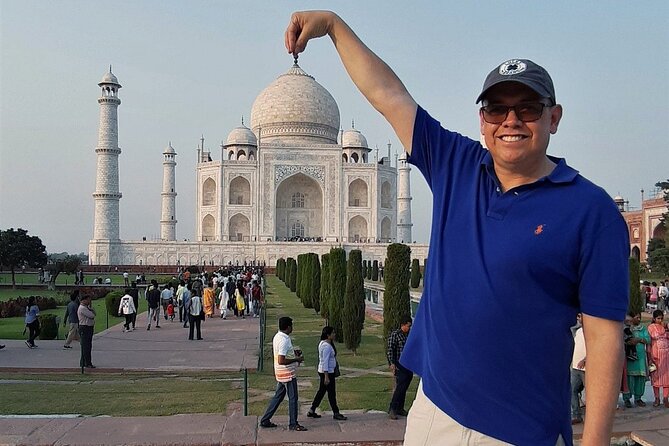
The big centerpiece is Taj Mahal. The tour frames it as an ivory-white marble mausoleum on the Yamuna’s right bank, commissioned in 1631 by Shah Jahan to house Mumtaz Mahal’s tomb, with Shah Jahan’s tomb also included. That story matters because it turns the visit into something more than a photo stop.
One practical detail I really like: a battery bus ride to and from the Taj Mahal parking lot up to Taj Mahal is included. If you’ve ever visited big complexes where you lose time to walking and parking chaos, this is the kind of inclusion that protects your energy.
You also cover:
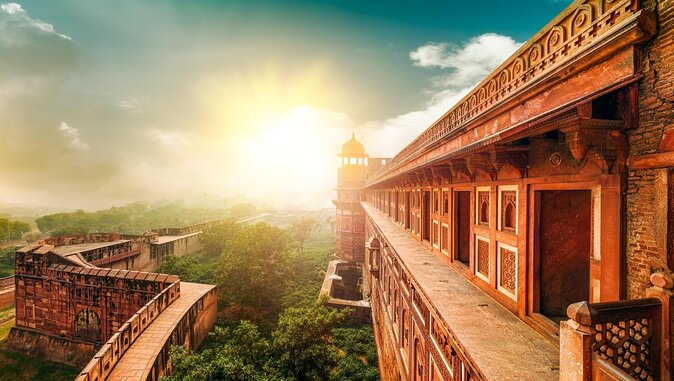
- Agra Fort (admission included), known as Agra’s Red Fort, tied to Mughal rule. It’s noted that Humayun was crowned there, and Akbar renovated it from 1565 onward.
Why this day feels smoother than doing it on your own
The transport is private and air-conditioned, and the plan connects Taj Mahal and Agra Fort under one guided rhythm. Even if you don’t stay for every moment inside each site, you’ll still understand the Mughal logic of the place rather than bouncing between random attractions.






Day 3 Fatehpur Sikri to Jaipur: Akbar’s old capital and a Sufi link
Day 3 shifts you away from the Delhi–Agra straight line. After breakfast, you go toward Jaipur and stop at Fatehpur Sikri, described as Akbar’s old capital. The highlights are clearly pointed out:
- Buland Darwaza, described as the world’s largest entrance gate
- Shrine of Sheik Salim Chisti
Then you continue with Panch Mahal (admission included). The plan links Panch Mahal to Akbar, built in honor of the Sufi saint Sheikh Salim Chisti, and it’s described as a standout example of that architectural style.
The value here is not only the “what,” but the “why.” The route doesn’t treat Fatehpur Sikri as separate. It’s presented as a connected Mughal setting: monumental entry, a spiritual center, and the layered architecture you’d expect around an imperial project.
After those stops, you arrive in Jaipur, check into your hotel, and overnight there.
Day 4 Jaipur: Amber, City Palace, Jantar Mantar, plus the extras that add up
Jaipur is where the Golden Triangle becomes visually fun. The day’s built around Amer/Amber Fort, then rounds out the city with royal and scientific landmarks—plus a few religious and cultural stops.
You start with an excursion to Amber Fort (listed as a longer stop window), then you visit Amer/Amber Fort itself (admission included). The description is classic and romantic: Amber is a fort palace, construction started by Man Singh I in 1592. Even if you don’t know the details before you arrive, the structure of the day makes it easy to follow the logic: start at the grand fort setting, then move outward.
From there, the itinerary includes Jal Mahal (Water Palace) for a quick look. It’s described as a palace in the middle of Man Sagar Lake, originally constructed in 1699 and later renovated. The short time slot is the point: it’s a visual breather between heavier monuments.
Then you move into royal Jaipur:
- City Palace of Jaipur (admission included), described as the royal residence and former administrative headquarters, with construction completed in 1732.
- Jantar Mantar (admission included), an observatory with 19 astronomical instruments built by Rajput king Sawai Jai Singh, completed in 1734, and noted for the world’s largest stone sundial.
You also get the kind of Jaipur add-ons that make a day feel more complete:
- Hawa Mahal, described as built from red and pink sandstone and extending to Zenana women’s chambers
- Albert Hall Museum (admission free), noted as the oldest museum of the state and functioning as Rajasthan’s state museum, designed by Samuel Swinton Jacob
- Birla Mandir (admission free), a white marble Lakshmi Narayan temple built in 1988
The real win on Day 4
The day isn’t just forts and palaces. It mixes power + planning + science (City Palace + Jantar Mantar) and adds quick cultural stops so Jaipur doesn’t feel like one long “look at buildings” stretch.
Day 5 wrap-up: transfer time without the scramble
Day 5 is essentially your exit day. After breakfast, you’re transferred to Jaipur or Delhi airport for your flight, or dropped at your destination point you provided (hotel, railway station, or any listed location).
Because the tour includes pickup and drop-off, you don’t have to suddenly solve logistics when your energy is lowest. You get a clean finish with fewer moving parts.
Drivers and guides: the difference between a tour and a headache
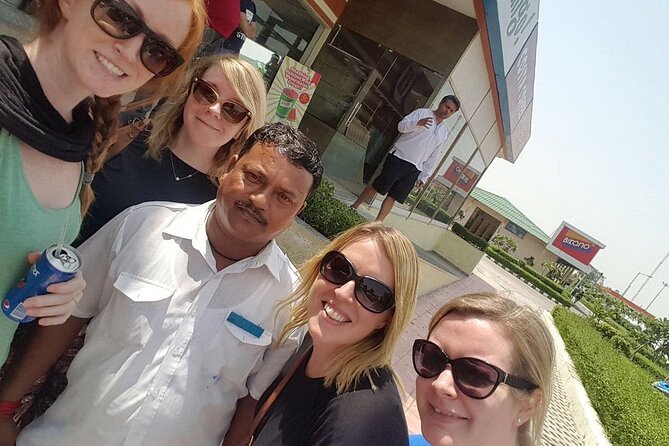
The most consistent praise you’ll see tied to this kind of trip isn’t about monuments. It’s about flow. Names that come up strongly include Sultan Singh and Shankar Singh, with emphasis on punctual, friendly, professional guidance. You’ll also see mention of Javed as a contact point for program adjustments and quick communication via WhatsApp.
Even if your driver isn’t the same person, the lesson holds: this tour is built around guided stops and timed movement. When the driver understands the rhythm, the day feels calm. When they don’t, you waste energy waiting, rerouting, and asking questions you shouldn’t have to ask.
Should you book this 5-day private Golden Triangle tour?
I’d book it if you want:
- A private, air-conditioned way to connect Delhi, Agra, and Jaipur with less stress
- A plan that covers classic monuments with English-speaking guidance
- Included basics that protect your budget, like breakfast, bottled water, and key admissions listed as included
I’d pause if:
- You care deeply about unstructured time. This plan is built to see a lot, and Day 1 and Day 4 especially pack major stops in one rhythm.
- You’re planning to spend lots of time shopping or lingering at a slower pace. This tour is efficient by design, and you’ll likely want to schedule extra personal time separately.
If your goal is the classic Golden Triangle hits—Delhi monuments, Agra’s Taj Mahal experience with the battery-bus convenience, and Jaipur’s fort-and-city mix—this tour gives you a lot of that for the price.
FAQ
FAQ
Is pickup from the airport or hotel included?
Yes. Free pickup and drop-off are included from the airport, hotel, or railway station, and you can share your drop point in Jaipur or Delhi.
Do I get breakfast on this tour?
Breakfast is included for 4 mornings at the hotel. Lunch and dinner are not included.
Are monument entrance fees included?
Entrance fees are included for the monuments listed in the tour plan. Some stops are listed as free, and others are listed as admission included.
What kind of transportation is included?
You get a private, air-conditioned vehicle with an English-speaking professional driver. Car size depends on group size (sedan, MUV, or van).
Is this tour truly private?
Yes. Only your group participates in this private tour/activity.
Can I choose when sightseeing starts?
The tour description states you have flexibility to start sightseeing at your desired time.
What is the cancellation window for a full refund?
You can cancel up to 3 days in advance of the experience start time for a full refund. Canceling less than 3 days before start time is not refundable.
Do I need a printout or ticket on arrival?
A mobile ticket is provided as part of the tour setup.