REVIEW · NEW DELHI
Four-Day Luxury Golden Triangle Tour to Agra & Jaipur From Delhi
Book on Viator →Operated by Hello India Tour · Bookable on Viator
Three cities in four days sounds intense.
This tour is interesting because it’s built for private-group comfort with an AC driver, plus a guide who keeps the day moving so you hit Delhi’s big sights, then sunrise Taj Mahal, and finish with Jaipur photo stops. I like that it’s structured enough to feel easy, but flexible enough that you still get time in the markets and viewpoints.
What I like most: the logistics are handled for you, from round-trip hotel transfers to using comfortable air-conditioned transport between cities. I also like the mix of famous UNESCO sites and classic Delhi/Agra/Jaipur landmarks, with a real guide explaining what you’re seeing instead of tossing you into crowds and hoping for the best.
One consideration: entrance fees are not fully included, and some stops are marked as ticket-not-included or exterior-only—so you’ll want to budget for monument payments on top of the tour price.
In This Review
- Key points
- Golden Triangle, luxury pace: what this tour does for your brain
- Day 1 in Delhi: Jama Masjid, Chandni Chowk rickshaws, and the UNESCO-to-temple route
- Pickup and the Old-Delhi opener
- Chandni Chowk with a rickshaw ride
- Red Fort exterior photos and quick cultural stops
- Humayun’s Tomb and Qutub Minar: where UNESCO shows up
- Lotus Temple and Swaminarayan Akshardham: faith and design contrast
- Finish the day in Agra
- Sunrise Taj Mahal and Agra Fort: why day 2 starts early
- Agra Fort and Itmad-ud-Daula: Mughal power and quieter elegance
- Fatehpur Sikri en route to Jaipur: a UNESCO break that keeps the drive from feeling endless
- Day 3 Jaipur: Amber Fort, Jal Mahal photo stops, and the City Palace/Jantar Mantar combo
- Amber Fort first: the big statement
- Jal Mahal: quick stop, interior tours are not available right now
- City Palace and Jantar Mantar: two kinds of history
- Hawa Mahal: the classic window view
- Evening time in Jaipur
- Guides can make or break the Golden Triangle: Harsh, Abbas, and Miki in context
- Price and what you truly get for $167.38 per person
- Who should book this luxury Golden Triangle, and who should pass
- Should you book this four-day luxury Golden Triangle?
- FAQ
- What’s included in the tour price?
- Where does pickup take place?
- Is this tour private or shared?
- How long is the tour?
- Are entrance tickets included for the monuments?
- What about meals during the tour?
- What’s the cancellation policy?
Key points
- AC car for four days with private guide time built in for each city
- Round-trip transfers from Delhi areas (including airport or railway station)
- UNESCO hits across Delhi, Agra, and Jaipur, timed to reduce stress
- Sunrise Taj Mahal to start the day with calmer light and fewer headaches
- Jal Mahal interior not available right now, so plan for photos and quick viewing
Golden Triangle, luxury pace: what this tour does for your brain
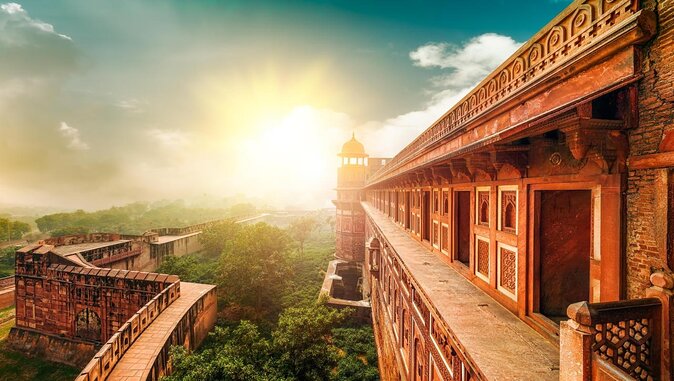
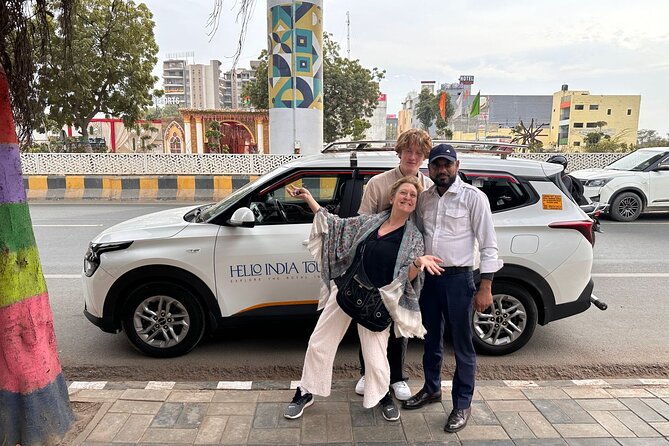
If you want the Golden Triangle—Delhi, Agra, Jaipur—without spending your trip on planning, this style of tour makes a lot of sense. You’re not driving or comparing ticket policies or figuring out which entrance to use. Instead, you get pickup, an air-conditioned vehicle, and a guide who’s there to interpret the places you’re rushing through.
This one also leans into comfort. You’re in a private air-conditioned car for the full run between cities, with car size options depending on your group (sedan for 1–2 people, 6-seater SUV for 3–4, and a 10-seater van for 5–10). That matters because road time can eat a day fast in India, and being comfortable makes the schedule feel doable rather than miserable.
Another thing I appreciate: the tour is a private group, meaning it’s only your people in the car and with the guide. Even though it’s booked as a package, you’re not stuck with a random crowd’s pace. And with an overall rating of 4.9 and a 98% recommendation rate, the service basics seem to land well for most people.
You can also read our reviews of more tours and experiences in New Delhi.



Day 1 in Delhi: Jama Masjid, Chandni Chowk rickshaws, and the UNESCO-to-temple route
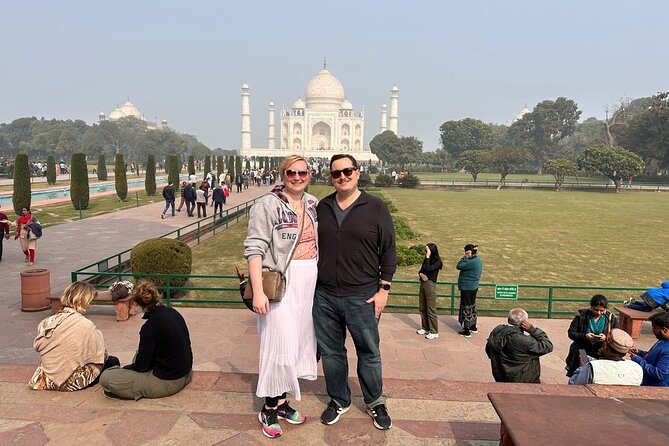
Delhi can go two directions at once: chaotic streets and huge architectural monuments. This day threads that needle with planned stops and a guide doing the talking so you don’t feel lost.
Pickup and the Old-Delhi opener
You start with pickup from many Delhi-area locations—including Gurugram, Noida, Ghaziabad, Faridabad, plus airport or railway stations. If you’re staying in a private residence, they can arrange pickup there too (by request). That’s helpful because it removes one more thing from your mental checklist.
Then you begin at Jama Masjid, India’s largest mosque, built in the mid-1600s by large-scale effort. The guide’s stroll-through approach is a good match for the courtyard vibe: you can look, breathe, and absorb without feeling like you’re being herded.
Chandni Chowk with a rickshaw ride
After that, your guide helps you hire a rickshaw to explore Chandni Chowk. This is the kind of experience that’s hard to do well on your own because you’d either overthink the streets or miss the best routes. Here, the guide essentially gives you permission to experience it properly—moving through the lanes, watching the market rhythm, and grabbing a snack if you want.
Just note: you’re on a tight day. If you want shopping time to be a big priority, you’ll still want to keep your expectations realistic and move with the group.
Red Fort exterior photos and quick cultural stops
Next, you get Red Fort from the exterior, with the guide explaining the monument’s background and giving you photo time. This “outside look + context” is a smart way to include a headline attraction without blowing hours on logistics.
The route continues with Gurudwara Bangla Sahib, known for its tank and long association with relief and community service. Then come the photo-friendly memorial and government landmarks: India Gate and the Rashtrapati Bhavan exterior. These are less about entry and more about understanding why the buildings sit where they do in modern Delhi.






Humayun’s Tomb and Qutub Minar: where UNESCO shows up
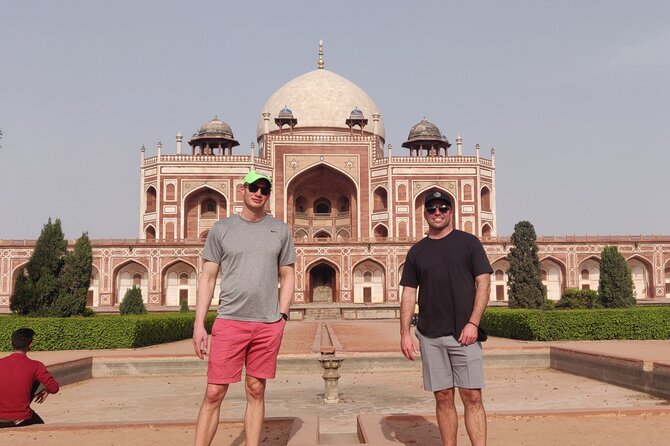
The day pivots into major Mughal and Indo-Islamic architecture with Humayun’s Tomb and Qutub Minar. Qutub Minar is a UNESCO World Heritage Site and a major reason people visit Delhi beyond the markets. If you’re trying to “see the real stuff” on a first trip, this part of the schedule is doing real work.
Lotus Temple and Swaminarayan Akshardham: faith and design contrast
To balance all that older architecture, you also stop at the Lotus Temple (free admission) and Swaminarayan Akshardham (also listed as free on the tour day). These places add a modern spiritual architecture contrast. Even if you’re not a deep religious traveler, you can still enjoy the design and the calm pacing compared to street-level Old Delhi.
Finish the day in Agra
By the end of Day 1, your driver takes you to Agra via the Yamuna Expressway, then you check into your hotel for rest. You’re not just “transported” here—you’re moved efficiently enough that you have a proper end to the day instead of arriving too late to do anything.
Sunrise Taj Mahal and Agra Fort: why day 2 starts early
Day 2 begins with an early trip to the Taj Mahal, with the focus on sunrise viewing. That timing matters. The light hits differently at dawn, and it typically feels less like a full-on sightseeing stampede than mid-morning. More importantly, starting early gives you daylight in Agra for the rest of the plan.
One practical tip: sunrise means you’ll be up earlier than you’d like. If you’re sensitive to early mornings, plan to treat this as the day where you trade sleep for payoff.
Agra Fort and Itmad-ud-Daula: Mughal power and quieter elegance
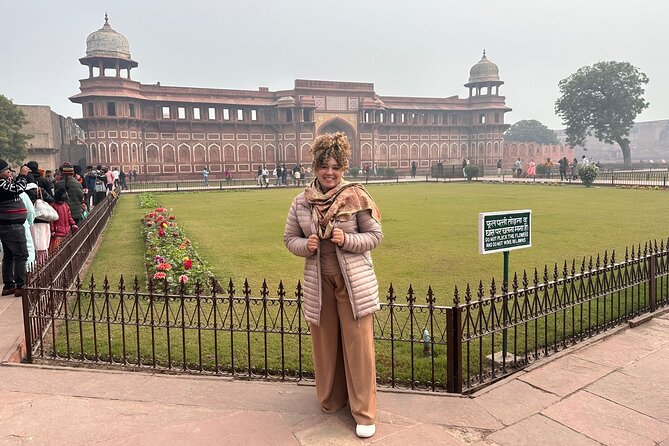
After the Taj, you move to Agra Fort. This was once the Mughal family residence, so you’re looking at architecture tied to authority and defense—not just palace glamour. From there, you go to Itmad-ud-Daula, often considered a more understated Mughal site compared to the Taj. It’s a good choice for travelers who want variety: grand monuments one hour, detailed calm the next.
Then you head toward Jaipur with a stop at Fatehpur Sikri (more on that next).
Fatehpur Sikri en route to Jaipur: a UNESCO break that keeps the drive from feeling endless
Road time between Agra and Jaipur is real. What makes this route workable is that it doesn’t treat the stop as an add-on—it treats it as a structured break.
So you pause at Fatehpur Sikri for a guided visit of the 16th-century complex. Fatehpur Sikri is UNESCO-listed, and it’s one of those places where the guide’s context makes everything more legible: why it was built, what you’re seeing, and how the architecture fits together. This is the kind of stop that turns “getting there” into “actually seeing something.”
The practical advantage: the stop breaks the monotony. Without it, the trip can feel like a long transfer day. With it, you get meaningful sightseeing built into the travel rhythm.
Day 3 Jaipur: Amber Fort, Jal Mahal photo stops, and the City Palace/Jantar Mantar combo
Jaipur is the day where the tour shifts from Mughal monuments to Rajput splendor and city planning.
Amber Fort first: the big statement
You start with Amber Fort, spending about two hours there. This stop is a cornerstone of Jaipur visits, and it sets the tone fast: big ramparts, layered courtyards, and architecture built for status. Going earlier in the day also gives you a better shot at comfortable touring before heat and crowds intensify.
Jal Mahal: quick stop, interior tours are not available right now
Next is Jal Mahal, the floating palace view over Man Sagar Lake. Here’s an important detail: interior tours are not possible at present due to disputes. So plan for what the stop is right now—short viewing time and photos, not a long architectural exploration inside.
This is one of those “read the room” moments. If you’re expecting a full visit, you’ll feel a little cheated. If you expect a scenic break, you’ll get exactly what you came for.
City Palace and Jantar Mantar: two kinds of history
Then you move to the City Palace, with time to see the complex formed when Maharaja Sawai Jai Singh II shifted his court from Amber to Jaipur in the early 1700s. The tour keeps you moving, but the focus stays on why the palace matters in Jaipur’s political story.
After that comes Jantar Mantar, a complex of nineteen architectural astronomical instruments designed by Sawai Jai Singh. This is not just a pretty structure. The guide’s explanations help you understand how people tracked time and the sky without modern equipment. If you like learning how cities were built around knowledge systems, this is a standout stop.
Hawa Mahal: the classic window view
Finally, you visit Hawa Mahal, the Palace of Wind. You’ll get photo time at the iconic façade with its many windows. Again, this is about timing and viewing rather than long interior wandering—so you’ll feel the difference between “I visited the inside” and “I saw the face of Jaipur.”
Evening time in Jaipur
After the main sights, you get an extra evening in Jaipur with free time to enjoy the city. That extra night is valuable because it helps you avoid the exhaustion of nonstop sightseeing without any downtime.
Guides can make or break the Golden Triangle: Harsh, Abbas, and Miki in context
The biggest difference between a tour that feels like a checklist and one that feels like a trip is the guide. Here, the guide coverage is central: there’s a private local guide for the sightseeing throughout the tour.
I’m also glad to see the company has consistently strong guide feedback tied to real behaviors. For example, Harsh is praised for being very informative and clear with history, and he also took people to a spice shop in Old Delhi—something you’d be unlikely to find quickly without guidance. Abbas is noted for being welcoming in Jaipur and for delivering a lot of sights efficiently without making it feel rude or rushed. Miki also gets credit for making a day in Delhi feel well-run and fun.
Here’s the balanced expectation: the structure can feel like a smart transport system plus local guidance in each city, rather than hours of slow wandering in one neighborhood. That’s not a flaw if you want efficiency. It becomes a mismatch if you’re the type who wants to follow your curiosity for long stretches without a schedule telling you what’s next.
Price and what you truly get for $167.38 per person
Let’s talk value, because this is the part that can trip people up.
The tour price shown here is $167.38 per person, for about four days. What you’re paying for is not just sightseeing—it’s the package glue: pickup/transfer support, a private AC vehicle for multiple days, guide time for the major sites, and taxes/service charges. If you’re comparing against the cost of booking drivers, guides, and hotels separately, bundling can be a real bargain—especially with the private-group setup.
But you should budget for the extras that aren’t included:
- Lunch, dinner, drinks are not included.
- Tips/gratuities are not included.
- Entrance fees for Old and New Delhi monuments are listed at $60 per person.
- For several specific sights (including major ones), the tour notes admission ticket not included, meaning you should expect to pay monument entry separately where required.
So the real way to judge value is this: if you’re going to want a comfortable car, a guide in each city, and a structured route that covers the big UNESCO names, then the price looks fair. If you only want one or two “must-sees” and prefer to self-navigate, the package may feel like paying for a lot of built-in movement.
Who should book this luxury Golden Triangle, and who should pass
This works best if you:
- Want comfort-first logistics across three cities
- Like a guide-led experience where someone tells you what you’re looking at
- Are short on time and want to hit the main UNESCO targets without planning stress
- Prefer a private group pace over joining larger crowds
You may want to skip or adjust expectations if you:
- Hate early mornings (the Taj Mahal sunrise day is core to this plan)
- Want long, unstructured hours in one market or neighborhood
- Have a very tight entrance-fee budget, since monument payments are not fully covered
Should you book this four-day luxury Golden Triangle?
I’d book this if you want a smooth, well-structured Golden Triangle that prioritizes private transportation, guides, and big UNESCO landmarks with minimal hassle. It’s especially appealing for first-time visitors who don’t want to wrestle with timing, routes, or ticket processes while traveling.
Before you go, do two quick checks:
- Confirm whether you’re choosing the option with three nights of hotel plus breakfast included.
- Plan money for monument entry fees you’ll pay on the side (the Delhi total is listed at $60 per person).
FAQ
What’s included in the tour price?
The tour includes round-trip hotel transfers from Delhi, a private air-conditioned car for four days, a private local tour guide for sightseeing, and all taxes and service charges. It also includes 3 night hotel accommodation with breakfast if you book the package option that includes hotels.
Where does pickup take place?
Pickup is available from any location in Delhi, Gurugram, Noida, Ghaziabad, and Faridabad. It can also include pickup from the airport or railway station, and pickup from private residences can be arranged on request.
Is this tour private or shared?
It’s a private tour/activity, so only your group participates.
How long is the tour?
The tour runs for about 4 days.
Are entrance tickets included for the monuments?
Not fully. Entrance fees for monuments in Old and New Delhi are listed as $60.00 per person and many specific sights are marked as admission ticket not included.
What about meals during the tour?
Lunch, dinner, and drinks are not included.
What’s the cancellation policy?
Free cancellation is available. You can cancel up to 24 hours in advance for a full refund. If you cancel less than 24 hours before the experience starts, the amount you paid will not be refunded.