REVIEW · ATHENS
Biblical Ancient Corinth Canal Epidaurus Nafplio Private Tour
Book on Viator →Operated by Yomadic.Tours & Transfers · Bookable on Viator
One day, three ancient zones. This private tour strings together the Corinth Canal, Ancient Corinth, and the Epidaurus healing world before finishing in romantic Nafplio. I like that it’s built for comfort and time, with an air-conditioned ride and an expert English-speaking driver to steer the story of each site.
My favorite part is the pacing you can control. You’re not stuck in a rigid group shuffle, and the driver’s willing to adjust along the way—especially useful when the heat pushes you to find shade, cafes, or a slower walk. One thing to keep in mind: site entrance fees and museums aren’t included, and some stops involve real walking and steep steps.
You’ll start early enough to feel the day, then settle into a mix of major landmarks and viewpoint moments. That combination makes the route feel efficient, but it also makes the day long. If you don’t like big single-day driving loops, this may feel like a lot.
In This Review
- Key highlights worth your attention
- Corinth Canal: the isthmus cut that turned mainland into an island
- Ancient Corinth: Saint Paul’s letters meet a city that got rebuilt twice
- Corinth Archaeological Museum: how to make sense of scattered ruins
- Temple of Apollo and Akrokorinthos: early Doric power and a fortress view
- Epidaurus: the theater where sound turns history into a trick
- Nafplio: Lion of Bavaria, Bourtzi photos, and forts with serious steps
- Price and what $240.93 really buys you for the day
- Who this private day trip is perfect for (and who should reconsider)
- Practical tips for a smoother long day
- Should you book this private Athens day trip?
- FAQ
- Is this tour really private?
- What’s the total duration?
- Does the price include entrance fees to archaeological sites and museums?
- What’s included with transportation and pickup?
- Will I have a licensed guide at the archaeological sites?
- Can I cancel for a full refund?
Key highlights worth your attention
- Corinth Canal with the 2,000-year dream: understand why ships once had to go the long way around the Peloponnese.
- Ancient Corinth + Paul’s connections: place the ruins in the context of early Christianity and Roman-era change.
- Epidaurus for acoustics, not just photos: you can try the classic pin or coin trick idea in the theater.
- Nafplio’s forts and viewpoints: Palamidi’s steps and views are the payoff.
- Private transport comfort: WiFi, A/C, bottled water, and a driver who keeps things moving without rushing.
Corinth Canal: the isthmus cut that turned mainland into an island
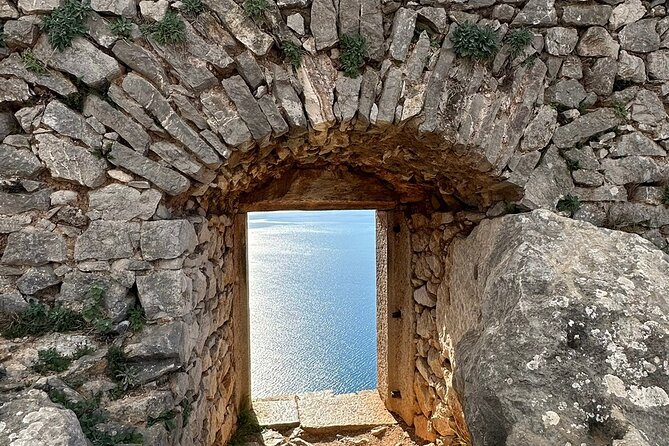
This is where your brain gets a geography lesson fast. The Corinth Canal cuts across the narrow isthmus and links the Gulf of Corinth with the Saronic Gulf. In practice, it separates the Greek mainland from the Peloponnese—so for travelers, it suddenly feels like you’re looking at a place that almost became an island.
What I like here is the long-view history. The canal was built in the late 1800s, but the idea was older than modern Greece. In ancient times, ships trying to cross between the Aegean and toward the Adriatic had to circle the Peloponnese—an extra 185 nautical miles. That’s the kind of detail that makes the canal feel more than a postcard stop.
You’ll also hear the Periander thread: the tyrant of Corinth (around 602 BC) is said to have conceived the canal idea, but technology wasn’t ready. So he built the diolkos, a stone road where ships could be transferred on wheeled platforms. Even if you only spend about 20 minutes here, the story clicks into place.
Practical note: it’s short, so don’t expect lingering stroll time. Go for photos, quick orientation, and then keep moving.
You can also read our reviews of more tours and experiences in Athens.

Ancient Corinth: Saint Paul’s letters meet a city that got rebuilt twice
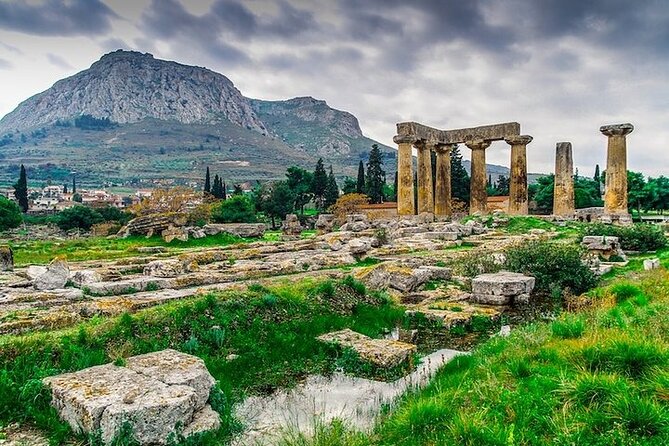
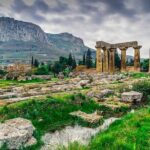
After the canal, the day shifts into big-time context. Ancient Corinth (Archaia Korinthos) sat on the Isthmus of Corinth—the neck of land joining the Peloponnese to mainland Greece. It was roughly halfway between Athens and Sparta, which helped make it a crossroads city.
For Christians, Corinth matters because of Saint Paul. First and Second Corinthians are part of the New Testament, and Corinth appears in Acts as part of Paul’s missionary travels. You also get a broader ancient reference point through Pausanias’ Description of Greece, which includes Corinth.
But what makes Ancient Corinth hit harder is the scale. This wasn’t a small backwater: estimates place the population around 90,000 in 400 BC. Then history smashes the story—Corinth was destroyed by the Romans in 146 BC, rebuilt in 44 BC, and later became the provincial capital. So you’re not just looking at ruins. You’re seeing a city that kept getting remade.
You’ll usually spend about 1.5 hours around Ancient Corinth. That’s enough time to spot major structures, get your bearings, and connect names you’ve seen in books to actual stones. The drawback is also obvious: entry fees add cost, and ruins can be confusing without a licensed guide on-site. If you like real interpretation at every stop, plan to hire an onsite guide or at least download an audio guide before you arrive.
Corinth Archaeological Museum: how to make sense of scattered ruins
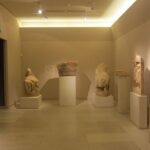
One of the best ways to get more from Ancient Corinth is to use the museum time. The Archaeological Museum of Corinth sits within the Ancient Corinth site area and was built in the early 1930s to present finds from recent excavations.
I love this stop for practical reasons. Outdoors, ruins can look like a pile of interesting rocks—especially if you’re jumping between sites all day. In the museum, you can slow down and see how pieces connect.
From what’s described, the museum/site experience connects to major elements like Hadgimoustafa spring, the Lechaion Road, the Basilica, the Fountain of Peirene, a Stoa, the Agora, the Odeion, temples, and a theatre. Even if you don’t memorize every label, you’ll walk away with a stronger mental map. The time here is about 40 minutes, and that feels about right for most people who want context without turning the day into museum school.
Also: museum entry fees aren’t included, so budget for that if you want the most complete experience.
Temple of Apollo and Akrokorinthos: early Doric power and a fortress view
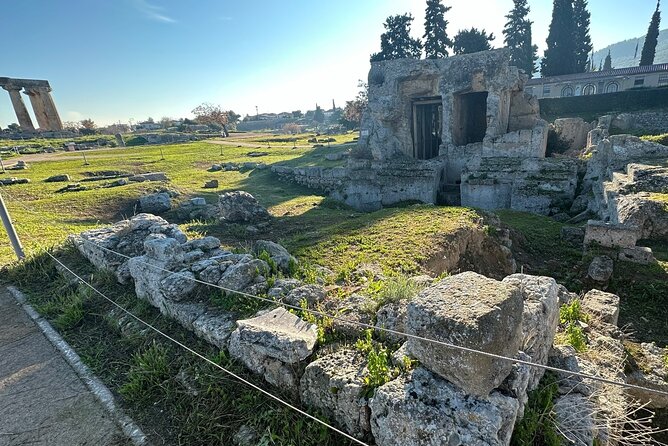
The day keeps building intensity. The Temple of Apollo at Corinth is described as one of the earliest Doric temples in the Peloponnese and the Greek mainland, with monolithic columns being rare in the ancient world. Even if you spend only around 10 minutes here, it gives you a sense of architectural ambition and how early Corinth signaled status through stone.
Then comes Akrokorinthos—also called Acrocorinth, or Upper Corinth. This is the massive rock acropolis overseeing the ancient city. The big idea is defensive. With its secure water supply, the fortress repeatedly served as a last line of defense in southern Greece. It controlled the Isthmus of Corinth, so it could repel enemies entering the Peloponnese by land.
This is a viewpoint stop, and viewpoint stops are where private tours shine. You’re not rushing to fit in ten minutes between buses. You can take a breath, look out, and let your brain connect the geography you saw at the canal to the high ground you’re standing on now.
Time here is about 30 minutes. Wear shoes with good grip. The terrain can be uneven, and you’ll want sure footing when you’re up close to old stone and drop-offs.
Epidaurus: the theater where sound turns history into a trick
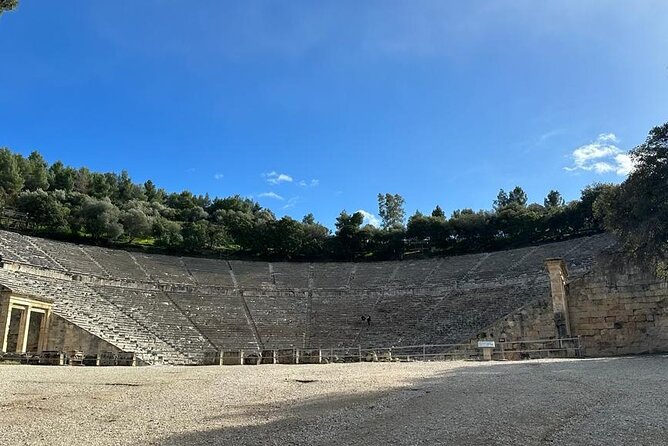
Now you switch from city power to healing mythology. Epidaurus is centered on the sanctuary world of Asclepius—connected to medicine and ritual healing in the ancient Greek imagination.
The highlight for most people is the Ancient Theatre of Epidaurus. It’s famous for both classic Greek construction and, more importantly, acoustics. The famous idea is that a pin or coin dropped on the stage can be heard even from the last seats. Even if you don’t attempt it, the fact that the design was meant for listening changes how you look at the space.
You’ll also see the Epidaurus Archaeological Museum with reconstructions of temples and columns with inscriptions. That museum time is around 30 minutes. It’s useful because it ties the sanctuary pieces together, not just the theatre.
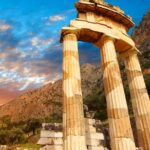
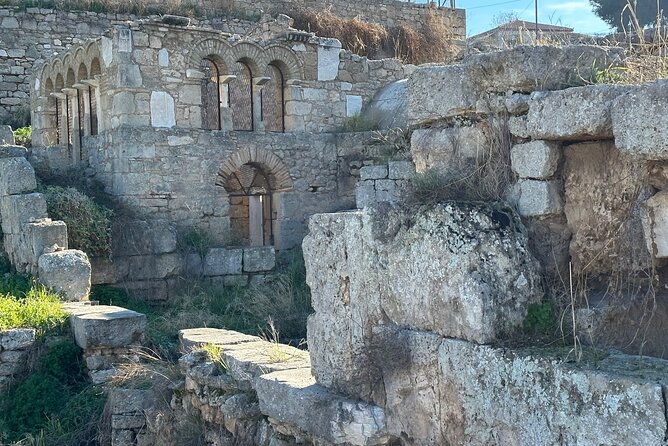
Add the sanctuary itself: the Temple/Sanctuary of Asklepios (Asclepius). It’s described as the main holy site and a rival to major cult centers like Zeus at Olympia and Apollo at Delphi. The temple dates to the early 4th century BC, and there’s a note about how it could have closed under late Roman anti-pagan edicts.
The structure of this part of the day matters because you’re getting three different ways of learning:
- how the theatre worked (sound and design)
- how the museum explains (reconstructions)
- how the sanctuary framed beliefs (medicine cult)
The time you’ll likely spend here totals around 1 hour for the theatre area segment, plus additional museum and sanctuary stops. Entry fees for the theatre area are not included, so check what you’re paying for before you go.




Nafplio: Lion of Bavaria, Bourtzi photos, and forts with serious steps
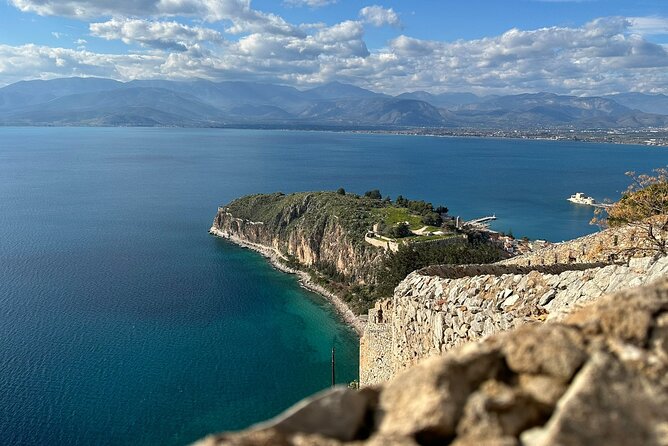
By the time you reach Nafplio, you’re probably ready for a slower pace. Nafplio is a seaport town expanded up the hills near the Argolic Gulf. In the Middle Ages it was tied to Argos and the lordship of Nauplia. Later, it served as the capital of the First Hellenic Republic and then the kingdom of Greece at the start of the Greek Revolution.
This part is all about mixing old stone with a real holiday vibe. The schedule includes time for lunch, coffee, shopping, and just wandering. That free time is valuable on a long day because it lets you cool off and pick a pace that fits you.
Then you get the photo moment: the Lion of the Bavarians. It’s carved into rock above Michael Ioannou Street, huge and commanding. The lion was made by German sculptor Christian Ziegel and commissioned by King Louis, father of Otto, in memory of Bavarian soldiers of Otto’s dynasty who died in Nafplio in 1833 during a typhoid epidemic. Locals have an unofficial story too: that it was the bitter things they ate that did them in—so you get a bit of local humor layered into the memorial.
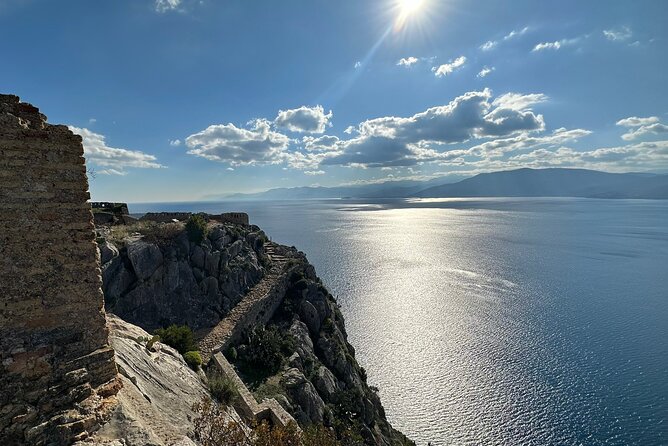
Time for Nafplio also includes Palamidi Castle, a standout fortress on a hill above the town. It’s described as one of Greece’s best-preserved castles, built by the Venetians during their second occupation (1686–1715). It’s full of loopholes and routes, and it’s associated with a notorious prison area tied to Kolokotronis.
Here’s the practical catch: it’s stairs and uneven terrain. The route includes the famous “number of steps” story—913 steps from town up to the fortress, though locals often joke it’s 999 steps. Either way, it’s a climb. If your legs don’t love uphill effort, treat this as an option you may want to pace carefully, or skip it in favor of more waterfront time.
Finally, you end with Bourtzi, the Venetian castle sitting out in the harbor. It’s only about a short stop, but it’s made for photos because it frames the water with a clear focal point.
Price and what $240.93 really buys you for the day
At $240.93 per person, this is priced as a full private day with transport and an expert driver. For many people, that’s the real value: you’re paying to avoid the logistics headache of stitching together separate buses, taxis, and multiple guide arrangements across a wide loop.
What you do get included:
- Private transportation in a modern vehicle with WiFi, A/C, and bottled water
- fuel and tolls included
- pickup and drop-off from Athens hotel/Airbnb or port (depending on your situation)
- expert English-speaking drivers
- group size vehicle split: 1–3 people in a sedan; 4–7 in a mini van
What costs extra (and can add up):
- entry to Ancient Corinth (€15.00 per person)
- Palamidi Castle (€20.00 per person)
- Epidaurus archaeological site (€20.00 per person)
- Corinth and Epidaurus museum entries (not included)
- plus other site entries marked as not included
So the value math depends on your style. If you like doing only the major stops and keeping museum time selective, you can control the total spend. If you want every museum door and every theatre area ticket, budget for it.
One more thing: this tour includes an expert driver for interpretation, but it does not include a licensed guide inside archaeological sites. That means you may still want to hire an onsite licensed guide for the big sites if you love details and historical storytelling.
Who this private day trip is perfect for (and who should reconsider)

This works especially well if you want:
- a long but well-paced day without coordinating multiple parts on your own
- air-conditioned comfort for a route that covers a lot of ground
- flexibility for heat and personal interests, like slowing down for viewpoints or taking extra time in Nafplio
It’s also a good fit across ages and ability levels because you can find shaded cafe breaks during Nafplio time, and the tour is private so you’re not stuck waiting for a crowd.
I’d reconsider if:
- you hate stairs and uphill walks (Palamidi is a real climb)
- you’re very price-sensitive once entrance fees are added
- you prefer a slower, one-area trip rather than a single-day “A to B to C” sweep
Practical tips for a smoother long day
A few details can make or break a day like this.
1) Plan for sun + walking. Even with A/C in the car, you’ll be outside at multiple sites. Bring sunscreen and wear supportive shoes.
2) Budget entrance fees early. Ancient Corinth, Palamidi, and the Epidaurus site have explicit costs, and museums are not included.
3) Ask for customization right away. The best experiences here come from adjusting timing to what you care about. Guides such as Giannis, Themos, and Chris have been praised for flexibility and not rushing, including adding extra sites when interests match.
4) If you want more depth, hire onsite context. The tour driver can explain, but museums and ruins often reward a licensed guide at the site—especially at Ancient Corinth and Epidaurus.
5) Use Nafplio time strategically. Pick one main goal (harbor photos, lunch spot, or a relaxed walk) and let the rest be optional.
Should you book this private Athens day trip?
If you want one day that connects the canal story, the Corinth city-state story, the Epidaurus healing story, and the real-life charm of Nafplio, this is a smart way to do it. The private vehicle with A/C, WiFi, and bottled water is a big comfort upgrade on a long loop, and the driver-led context helps you understand what you’re seeing without turning the day into a scavenger hunt.
I’d book it if your priorities include major ancient sites plus viewpoints and a proper break for lunch. I’d think twice if you dread steep climbs or you’d rather spend more time in fewer places.
FAQ
Is this tour really private?
Yes. It’s listed as a private tour, meaning only your group participates.
What’s the total duration?
The tour runs about 8 hours 30 minutes (approximately).
Does the price include entrance fees to archaeological sites and museums?
No. Entrance fees are not included, including Ancient Corinth (€15.00 per person), Palamidi Castle (€20.00 per person), and the archaeological site of Epidaurus (€20.00 per person). Museums for Corinth and Epidaurus are also not included.
What’s included with transportation and pickup?
Pickup and drop-off service is included from Athens hotel, Airbnb residence, or the port. The tour uses a modern private vehicle with WiFi, A/C, and bottled water.
Will I have a licensed guide at the archaeological sites?
No. An expert English-speaking driver is included, but a licensed guide to enter archaeological sites is not included.
Can I cancel for a full refund?
Yes. You can cancel up to 24 hours in advance for a full refund. The experience also depends on good weather; if canceled due to poor weather, you’ll be offered a different date or a full refund.