REVIEW · TANGIER
3 Days Private Luxury Tour Merzouga Desert Ending in Marrakech
Book on Viator →Operated by Fes City Travel · Bookable on Viator
Three days in the Sahara feels unreal. From private luxury tent nights in Merzouga to camel rides and sunset sand views, this trip turns a long route into the kind of story you remember. I love how the desert part feels like the main event, with dinner, Berber music, and a wood fire keeping the night social and easy.
I also like the way the drive is broken up by real, scenic stops, not just pit stops: cedar forests with macaques, palm groves in the Ziz Valley, and famous canyons on Day 2. One drawback to plan for: you’ll spend serious time in the car, and lunch plus monument entrance fees are not included.
In This Review
- Key Highlights I’d Plan Around
- Why This Fez-to-Marrakech Sahara Route Works in 3 Days
- Comfort on the Road: Air-Conditioned Transport and a Real Driver
- Day 1: Cedar Forests, Ziz Valley Palms, and a Luxury Dune Camp at Sunset
- Fez to Ifrane: High Atlas Beginnings and Cedar Forest Time
- Midelt and the Ziz Valley: A Lunch Break and a Palm-Shaded Contrast
- Erfoud to Merzouga: Oasis Memories to Real Dunes
- Night at the Camp: Dinner, Berber Music, and Wood-Fire Atmosphere
- Day 2: Sunrise Camels, Rissani Market, Todgha Gorges, and the Way to Ouarzazate
- Rissani: Berber Market Energy Near the Sand
- Todgha Gorges: Limestone Canyon Views
- Valley of Roses and Boumalne Dadès: An Oasis-Edge Color Story
- Ending Day 2: Luxury Hotel Time in Ouarzazate or Boumalne Dadès
- Day 3: Taourirt Kasbah, Ait Ben Haddou, and the Marrakech Finish
- Ouarzazate: Gateway Energy and Film-World Sight
- Taourirt Kasbah: Historic Fortified Residences
- Ait Ben Haddou: The Pre-Saharan Ksar You Keep Seeing in Photos
- Tizi n’Tichka to Marrakech: High Atlas Pass Timing
- Price and Value: What You Pay For (and What Costs Extra)
- Who This Tour Suits Best (and Who Should Think Twice)
- Should You Book This 3-Day Private Luxury Sahara Tour?
- FAQ
- Where does the tour start and end?
- Is pickup included?
- What’s included in the desert experience at Merzouga?
- What meals are included?
- Does the price include monument entrance fees?
- What kind of transportation is used?
- What languages are supported?
- What’s the cancellation window for a full refund?
Key Highlights I’d Plan Around
- Private luxury tent in the Merzouga dunes with two dinners and two breakfasts included
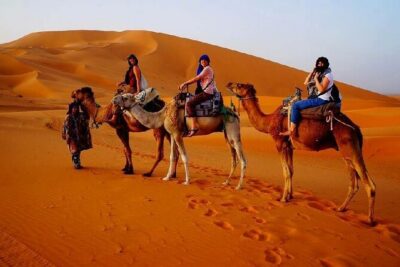
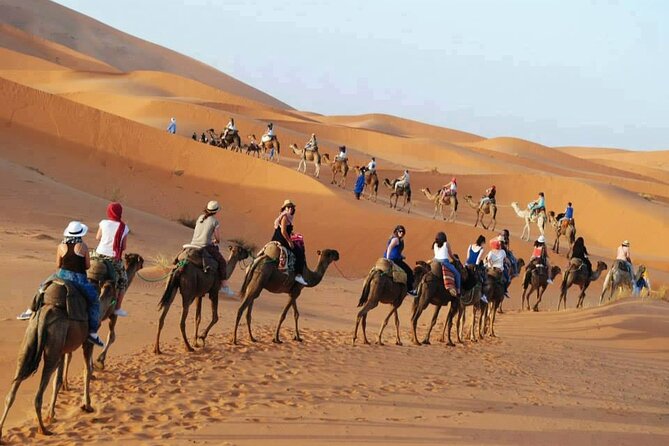
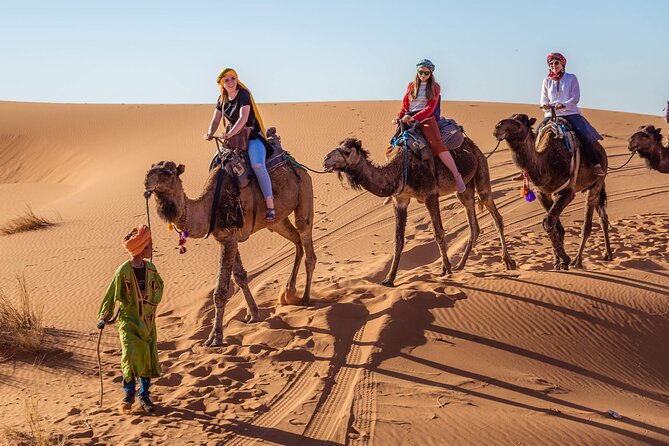
- Camel ride setup: 4×4 transfer to camp, then camel time to Merzouga, plus a sunrise return by camel
- Stops that add texture: Ifrane cedar forest macaques, Ziz Valley palm shade, Todgha Gorges, and the Rose Valley region
- World-famous architecture on the final day: Taourirt Kasbah and Ait Ben Haddou on the road to Marrakech
- Driver quality matters here: clean, comfortable vehicles and safe, attentive driving are a recurring theme with drivers like Sufyan, Badar, and Pedro
Why This Fez-to-Marrakech Sahara Route Works in 3 Days
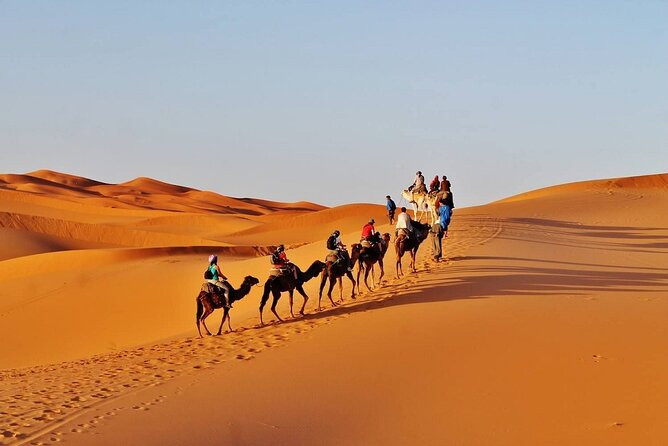
If you only have a few days, you need two things: the right pacing and the right “anchor” experiences. This tour gets both. The anchor is Merzouga—its dunes, the overnight camp, and the camel time—while the pacing is handled by a steady sequence of stops across the Middle Atlas and High Atlas regions.
You’re not just traveling between Fez and Marrakech. You’re layering Morocco’s different moods: cooler mountain air around Ifrane, green-and-date-focused valleys like the Ziz, then the Saharan feeling when the dunes start to appear. By the time you reach the camp, it doesn’t feel like a sudden jump into nowhere; it feels like the journey made its own way there.
You can also read our reviews of more tours and experiences in Tangier.
Comfort on the Road: Air-Conditioned Transport and a Real Driver
You start with pickup around 7:30 a.m. from your hotel in Fez, then you head south in a comfortable, air-conditioned minibus or car. That matters more than it sounds. Long-distance driving in Morocco is part of the deal, but comfort reduces the “drain” so you can actually enjoy the stops.
The tour includes an English and French speaking driver, and this is one place where the experience quality shows. In the stories I’ve heard from other journeys on this route, drivers such as Sufyan, Badar, and Pedro stand out for being friendly, communicative, and careful behind the wheel, plus they help you understand what you’re seeing. In at least one case, a driver’s mother even shared cookies during the trip—small touch, big morale boost when you’re on the road for hours.
Still, be honest with yourself: this is a drive-heavy itinerary. If you prefer slow travel with minimal seat time, you may find the schedule tight. For most people, though, the structure is what makes it work.
Day 1: Cedar Forests, Ziz Valley Palms, and a Luxury Dune Camp at Sunset
Day 1 is about leaving Fez and gradually changing the scenery until Merzouga becomes real. The tour crosses the Middle Atlas and includes several meaningful stops, each with its own vibe.
Fez to Ifrane: High Atlas Beginnings and Cedar Forest Time
Leaving Fez early gives you daylight for the Middle Atlas. Ifrane is the first notable pause. It sits at about 1,650 meters altitude and is nicknamed Little Switzerland for its architecture and climate. Even if you don’t make it a full town exploration, the stop gives your body a reset and helps break up the day.
Then comes the cedar forest stop: Cedre Gouraud Forest, where you can see Barbary macaques and enjoy the butterfly-filled, outdoor feel. There’s no requirement to hike hard. The goal is simple: slow down, watch wildlife if you’re lucky, and take photos while the mountains still feel close.
A practical note: if wildlife viewing is a priority for you, keep your camera handy and give yourself a little patience. Wildlife doesn’t queue on a schedule.
Midelt and the Ziz Valley: A Lunch Break and a Palm-Shaded Contrast
Midelt is a quick lunch break area with a small Moroccan-town feel in the Atlas Mountains. You can use this hour to eat without rushing and recharge before the desert transition starts.
After that, you reach the Ziz Canyon / Ziz Valley stop. This is where the trip shifts from mountains to a more oasis-like rhythm. You get palm groves, date-related stops, and panoramic views that feel like a preview of what’s coming. Even a 25-minute stop can be satisfying here because you’re changing your perspective: water and shade appear, and the photos look different.
Erfoud to Merzouga: Oasis Memories to Real Dunes
Erfoud is an oasis town near the Sahara, and it’s described as a place tied to palm trees and local culture. It’s also positioned as a jumping-off point for Erg Chebbi, the big-sand area associated with Merzouga.
Then the day builds to Merzouga itself. Once you arrive, you take a 4×4 jeep transfer to the luxury camp. This part is smart because it saves time and keeps you from walking heavy sand after a long day. Then you explore the dunes with time before sunset. Watching the light shift over the sand is one of Morocco’s easiest wow moments, and the tour schedules it for maximum effect.
Night at the Camp: Dinner, Berber Music, and Wood-Fire Atmosphere
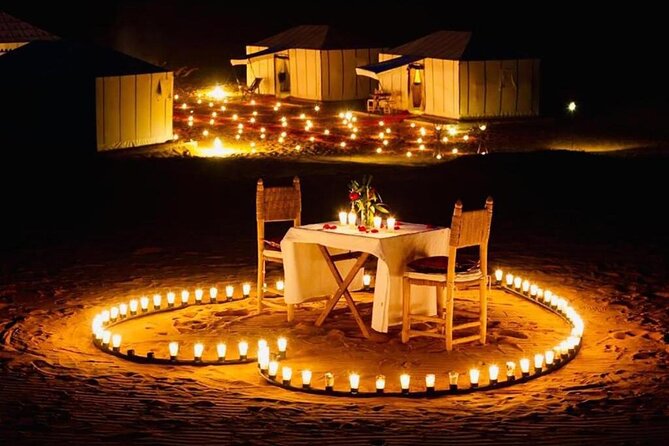
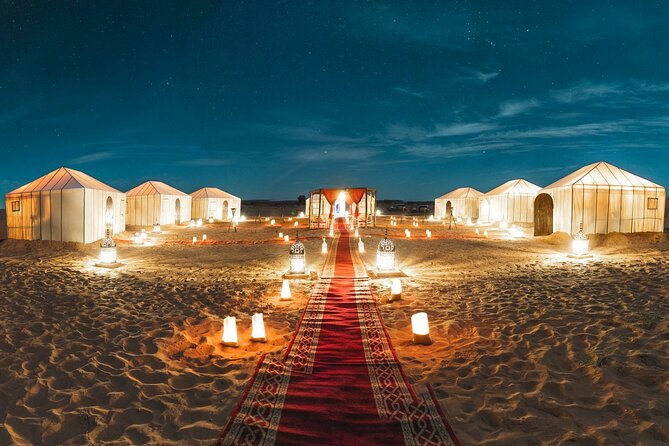
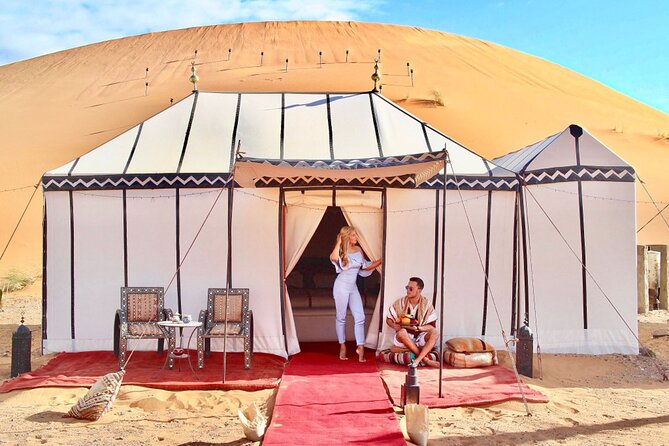
Your camp experience isn’t just a bed. You get a delicious dinner, Berber music, and a wood fire evening. The tour also includes a private luxury tent, which makes the night feel more personal than basic desert camping.
The camel part happens in a later window on Day 2, but you’ll already feel the rhythm of the desert on Day 1. You arrive, you settle, you see the dunes under changing light, then you’re fed and entertained. That’s a good formula for people who want adventure without turning it into survival-mode travel.
Day 2: Sunrise Camels, Rissani Market, Todgha Gorges, and the Way to Ouarzazate
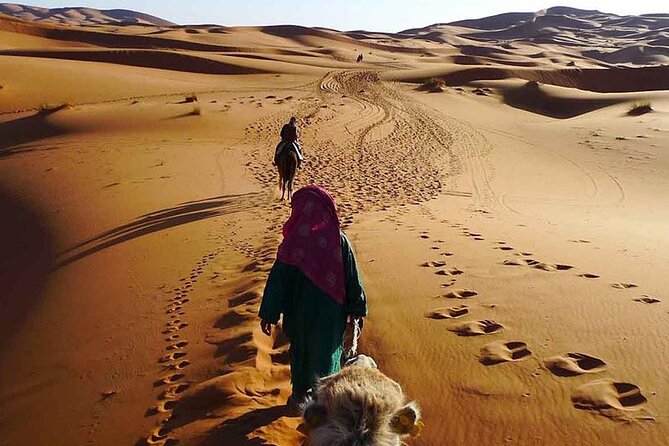
Day 2 starts early, which is typical for sunrise experiences. You wake for sunrise, enjoy breakfast, and return by camel to Merzouga village. If you want the real “Sahara feeling,” this is the moment you’re aiming for. Sunrise light on sand has a way of making everything look softer and quieter, even if you’re still in the middle of a busy human world.
Rissani: Berber Market Energy Near the Sand
After that camel return, you stop in Rissani for a Berber market visit. This is close to the Erg Chebbi area, so it’s a cultural stop that also reinforces where you are geographically.
A market stop is never fully predictable. You’ll get more value if you treat it as an opportunity to watch and ask questions rather than expecting one set attraction.
Todgha Gorges: Limestone Canyon Views
Then you head to Gorges du Todgha. These are limestone river canyons (wadis) carved by the Todgha and Dadès rivers. The tour gives you a short stop, but the setting is visually dramatic enough that even a brief visit can feel like a full “nature” moment on the road.
The trade-off is time. You’ll see a lot in three days, so you won’t get a long hike here. If you love slow canyon walking, you might want extra time in the future, but for this itinerary, it hits the highlight without dragging.
Valley of Roses and Boumalne Dadès: An Oasis-Edge Color Story
Next come two short stops connected to rose cultivation and the Dadès Valley area: the Valley of Roses (Kelaat M’Gouna region) and Boumalne Dadès. The area is irrigated by the Asif M’Goun river, and rose cultivation is practiced in the main village.
Even if rose-season timing isn’t guaranteed on your exact travel dates, the point is the transition. You go from Saharan dunes to agricultural valleys and river-fed oases. You feel the Atlas Mountains working as a water source, and that makes the whole route feel more connected.
Ending Day 2: Luxury Hotel Time in Ouarzazate or Boumalne Dadès
Day 2 ends with a drive to a luxury hotel in Ouarzazate or Boumalne Dadès. You get pool time and dinner plus entertainment with the group there.
That matters because it lets you recover after two big days: desert camp night energy plus a second day of driving and sightseeing. In a 3-day tour, a real “sit-down” evening is not a luxury. It’s what keeps the trip enjoyable on Day 3.
Day 3: Taourirt Kasbah, Ait Ben Haddou, and the Marrakech Finish
Day 3 keeps the theme of architecture on the move. You start in Ouarzazate, continue to Ait Ben Haddou, then cross the High Atlas via Tizi n’Tichka before reaching Marrakech.
Ouarzazate: Gateway Energy and Film-World Sight
Ouarzazate is described as the gateway to the Sahara Desert, with the area known for rugged scenery and fortifications. You also get a look at Taourirt Kasbah and a famous movie studio. In practical terms, it’s a day where you’ll see southern Moroccan architecture that’s so recognizable it shows up in films.
The advantage here is efficiency. In just a few hours, you get cultural depth plus a clear sense of why this area has been used as a film set.
Taourirt Kasbah: Historic Fortified Residences
Kasbah Taourirt is a complex of fortified residences with origins that trace back through local families and later enlargement by the Glaoui family in the 19th century. You’ll have a stop time specifically for this, and you should treat it as your architecture “anchor” before the grander, walled village look comes next.
Important: the tour notes the Taourirt Kasbah entrance ticket is not included. That’s one place you should plan to pay if you want full access. If you’re budget-tight, you can still take outside photos, but interior views will be the payoff.
Ait Ben Haddou: The Pre-Saharan Ksar You Keep Seeing in Photos
Ait Ben Haddou is a spectacular example of southern Moroccan earthen architecture: a ksar, with buildings grouped behind high walls reinforced by corner towers. It’s the classic image of Morocco’s south, and the stop is long enough to walk through and take in why it’s so famous.
Entrance fees are not listed as included here either, so again, expect to pay on the ground if you want complete access. This is normal for major sites, but it does affect how you should budget overall.
Tizi n’Tichka to Marrakech: High Atlas Pass Timing
Tizi n’Tichka is the mountain pass connecting southeast Marrakech to the Ouarzazate region. It’s a practical way to wrap the trip: you cross out of the mountain zone and get your arrival into Marrakech timed for daylight.
By the time you finish, you’ll have gone from desert dusk to thick Atlas roads to Marrakech city end. It’s a strong “end cap” for a short itinerary.
Price and Value: What You Pay For (and What Costs Extra)
At $756.10 per person for about 3 days, you’re paying for a package that handles the hard parts: air-conditioned transport, driver coordination, a camel ride experience, 4×4 transfers to the camp, a private luxury tent, and multiple meals. You also avoid the headache of stitching together transport and overnight stays on your own.
What’s not included is where you should budget a bit more:
- Lunch (not included)
- Entrance fees to monuments (Taourirt Kasbah is specifically noted; Ait Ben Haddou also falls under monuments with entrance fees not included)
So the true cost depends on your willingness to pay for entrances and how you handle lunch. If you’re the type who wants to see sites fully, add a little buffer to your spending. If you’re flexible and happy with outside viewing, your extra costs may be lower.
Also, this is private in the sense that it’s only your group on the experience. That’s a big value point if you want control of timing and a more personal driver relationship, even though you’re still following a set route.
Who This Tour Suits Best (and Who Should Think Twice)
This tour is best for you if:
- You want a Sahara camp with a real upgrade: private luxury tent plus dinner and music
- You like structure and hate planning details across multiple days
- You want a balanced hit of culture and scenery: cedar forests, palms, canyons, kasbahs, and ksar architecture
- You value safe, attentive service and comfortable transport, which is repeatedly associated with drivers like Sufyan, Badar, and Pedro
It may be less ideal if:
- You strongly prefer minimal car time and more stops with longer stays
- You don’t want to deal with additional on-site costs for entrances and lunch
Should You Book This 3-Day Private Luxury Sahara Tour?
I’d book it if you want a focused Fez-to-Marrakech desert experience where the desert night isn’t basic and the sightseeing isn’t random. The combination of private luxury tent, camel time, and a clear Day 3 architecture finale is exactly what you want from a short trip.
Before you lock it in, do three quick checks:
- Plan for lunch and monument entrances not being included
- Expect early mornings and long drive days, so build in patience
- If you’re traveling as a small group, ask how the noted group discount works in practice
If that fits your style, this is the kind of Morocco trip that feels like it hits the right notes without dragging.
FAQ
Where does the tour start and end?
The tour includes pickup from your hotel in Fez around 7:30 a.m., and the itinerary ends in Marrakech.
Is pickup included?
Yes, pickup from your hotel is offered.
What’s included in the desert experience at Merzouga?
You get a transfer by 4×4 to the luxury camp, a camel ride, and the camp experience includes dinner with Berber music and a wood fire. You also return by camel to Merzouga village the next morning.
What meals are included?
Breakfast is included for two mornings, and dinner is included for two evenings. Lunch is not included.
Does the price include monument entrance fees?
No. Entrance fees to monuments are not included.
What kind of transportation is used?
You travel in an air-conditioned minibus or car, and you have a 4×4 transfer to the luxury camp in Merzouga.
What languages are supported?
The driver speaks English and French.
What’s the cancellation window for a full refund?
You can cancel up to 3 days in advance of the experience for a full refund. If you cancel less than 3 days before, the amount paid is not refunded.