REVIEW · MIAMI
Miami Beach: Luxury Private 50-min Airplane Tour
Book on Viator →Operated by Magic Air Tours · Bookable on Viator
Miami looks different from 1,000 feet. This private 50-minute airplane tour strings together some of the most expensive coastline in Florida, plus mansion-lined islands, with a real pilot talking the whole time through your headset.
I especially like that you get window seats and a tight route that covers a lot of ground in under an hour. I also appreciate the small-aircraft feel: it’s calm, you’re not packed in like a bus, and the plane setup is built for sightseeing. One heads-up: the live narration can be hit-or-miss depending on the pilot’s clarity, so don’t expect every sentence to land perfectly through the headphones.
In This Review
- Key points at a glance
- Miami from 1,000 feet: what this private Cessna tour is really like
- Over South Miami and Biscayne Bay: the route that sets up the whole skyline show
- Why this first stretch is worth your time
- Fisher Island and Bal Harbour: the private-boat world from above
- A practical note on narration
- Sunny Isles to Downtown: how the skyline looks when it’s not blocked
- Intracoastal Waterway, Star Island, and Palm Island: mansion views with real context
- What makes this section special (and what to watch for)
- The Venetian Causeway islands: recognizing six islands from one flight
- Coral Gables and Coconut Grove on the return: the neighborhoods behind the postcard
- Live narration through headsets: what you can expect and how to get the best version
- Value check: $118.68 per person plus landing fees for 50 minutes in the air
- Who gets the best deal
- What to bring, what not to bring, and how not to ruin the flight
- Safety, comfort, and who should skip this flight
- Should you book this Miami airplane tour?
- FAQ
- Where does the tour depart from?
- How long is the Miami airplane tour?
- What airplane is used for the tour?
- When should I arrive for check-in?
- Is parking available at Miami Executive Airport?
- What should I bring?
- Can I take photos or videos?
- Is window seating guaranteed?
- Are there weight or capacity limits?
Key points at a glance
- Private flight for small groups (minimum 2, maximum 3), so you’ll feel more like a couple on an outing than a crowd.
- Live pilot commentary through individual headsets, so you get context while you look, not after.
- Cessna 177 Cardinal is ideal for views, with everyone having a window seat.
- A high-end island route that includes Fisher Island, Bal Harbour, Sunny Isles, and the Venetian Causeway islands.
- Photos and videos are allowed, which matters when colors and skylines look unreal from above.
- Weight limits and small-bag rules are real, so pack light and double-check limits before you go.
Miami from 1,000 feet: what this private Cessna tour is really like
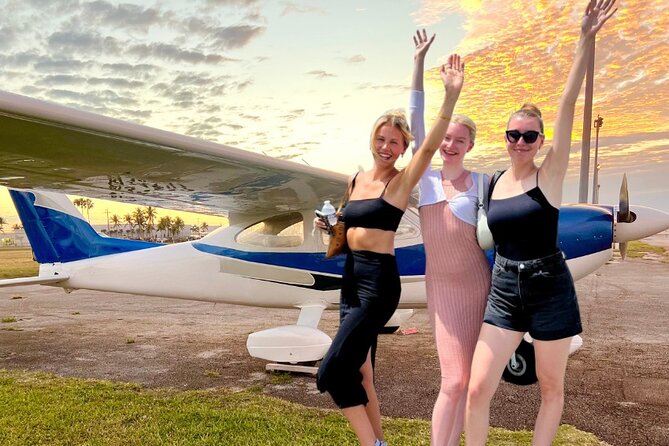
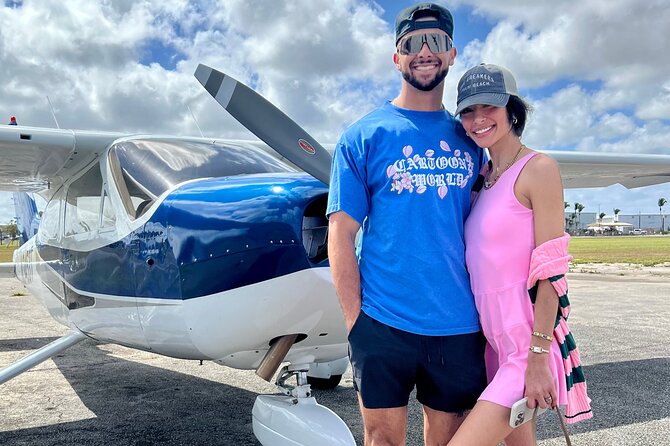
You’re flying out of Miami Executive Airport, then cruising over the neighborhoods, bays, and gated islands that make Miami’s waterfront so famous. The aircraft is a Cessna 177 Cardinal, a small plane chosen specifically for sightseeing, which means you’re close to the windows and the views stay crisp.
The biggest “wow” factor is simple: you can actually see how everything fits together. From the air, the coastline curves, islands stack like stepping stones, and the Intracoastal Waterway looks like a ribbon feeding the city. Add the fact that you’ll have airplane headsets and live intercom narration, and you’re not just looking—you’re getting a guided tour in real time.
The tour length is short enough that it feels easy, but long enough to cover plenty of Miami. It’s listed as about 50 minutes to 1 hour, and you’ll typically be in the air long enough to spot skyline sections, shoreline mansions, and the bright resort stretches along the barrier islands.
You can also read our reviews of more tours and experiences in Miami.


Over South Miami and Biscayne Bay: the route that sets up the whole skyline show
After check-in at 14359 SW 127th St (Miami Executive Airport), your flight starts by heading over South Miami, Biscayne Bay, and Key Biscayne. This is where the scenery transitions from “city blocks” into “water + skyline,” and the perspective changes fast.
Biscayne Bay matters because it gives you the contrast Miami is known for: calm water next to dense development. Key Biscayne helps you understand the geography—how the ocean-facing land and the bay-facing water create different moods and colors in the same flight path.
Then the tour moves into one of its signature moments: Fisher Island.
Why this first stretch is worth your time
If you’ve only seen Miami from land, you might think it’s mostly about buildings. From above, you learn it’s also about ownership patterns: the coastline is segmented, access is controlled, and the best views come with private frontage.
You’ll also be learning the “shape” of Miami in the air, which makes the later islands easier to recognize when you’re seeing them from a second angle on the return leg.
Fisher Island and Bal Harbour: the private-boat world from above
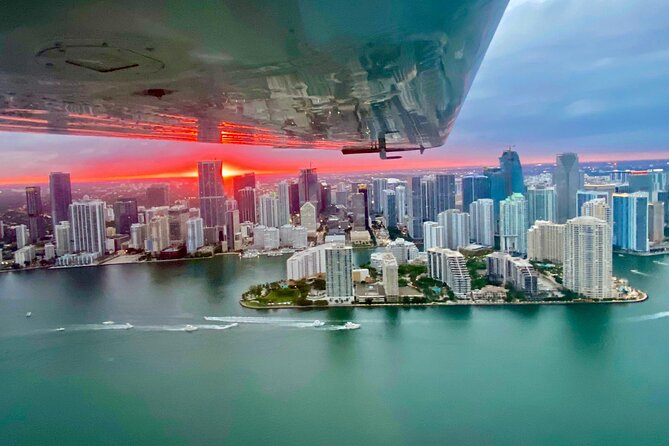
One of the standout segments is your pass over Fisher Island, described as accessible only by private boat. That detail isn’t just trivia. From the air, you can see exactly why it feels separate—water channels around it, controlled access, and a built environment that looks designed to block the outside world.
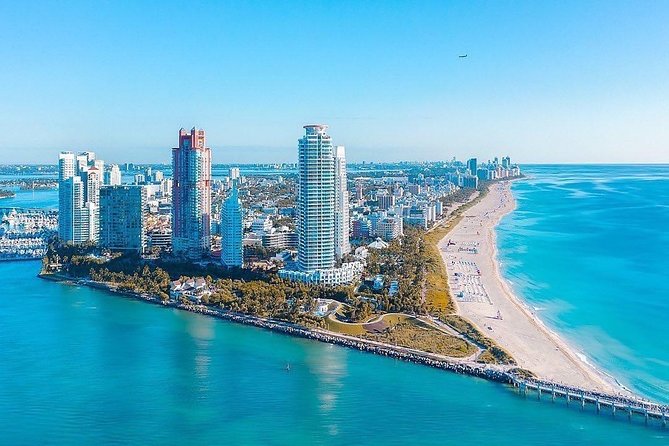
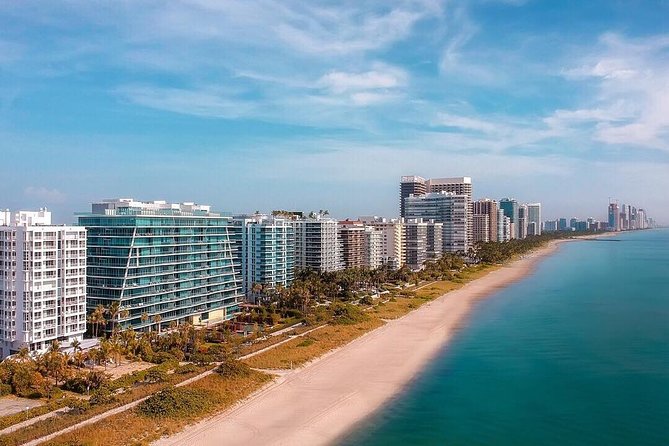
Next you’ll float over Bal Harbour and continue toward Sunny Isles. These areas are visually different from each other: Bal Harbour has that sleek, resort-luxury vibe, while Sunny Isles shows more of the shoreline rhythm—buildings lined up along the water with the ocean close by.
If you’re a couple, this part of the tour usually lands best. It’s romantic without trying too hard, and you get that “we’re flying over places we only ever see on postcards” feeling—except you can actually understand the distances.
A practical note on narration
Even though the tour is built around live commentary, one earlier experience shared that a few lines on the headset weren’t super clear. The fix is easy: keep your headset on steady, and if something sounds garbled, ask for clarification when the pilot pauses between segments. Most of the time, it’s the headphone volume or timing—not the information itself.






Sunny Isles to Downtown: how the skyline looks when it’s not blocked
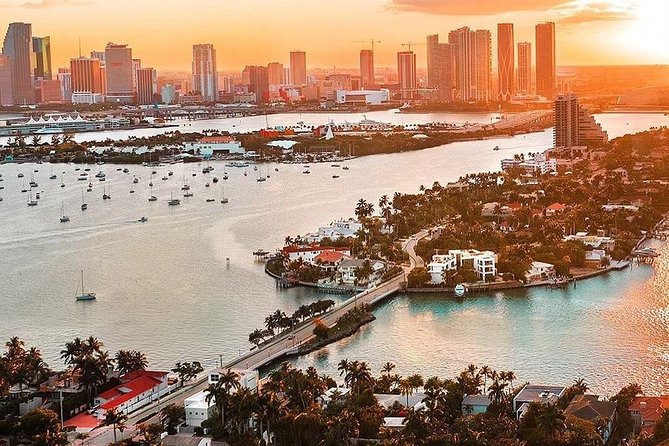
As you go along, you’ll get a bird’s-eye look of skyscrapers in Sunny Isles Beach, then later the tour includes views of Miami Downtown from the Biscayne Bay side. This is one of the most useful ways to see a city like Miami.
From the ground, downtown is often framed by trees, highways, or distance. From the air, you get the geometry: tower clusters, waterfront edges, and how far the city stretches before the water takes over again.
There’s also a realism here that you don’t get with typical sightseeing. Miami’s skyline isn’t just a set of iconic buildings; it’s an arrangement shaped by the coastline. Watching the skyline appear behind the water tells you where you are without needing a map app.
Intracoastal Waterway, Star Island, and Palm Island: mansion views with real context
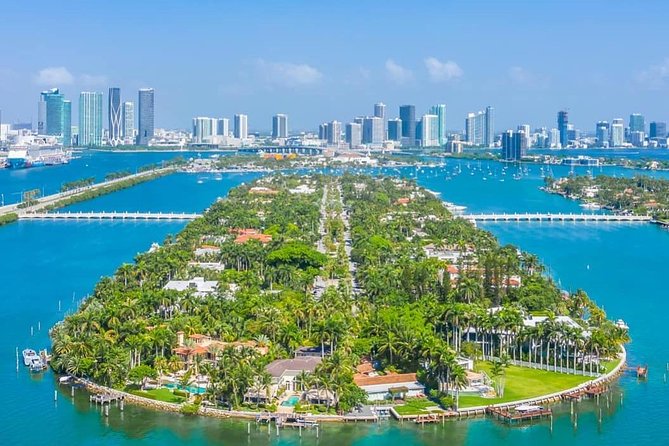
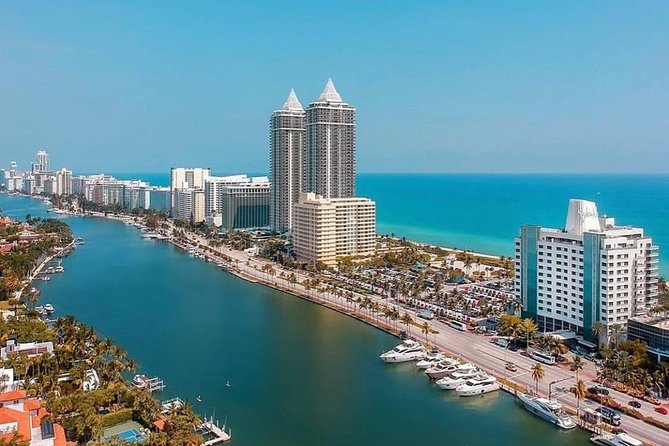
On the way back, your route includes a pass over the Intracoastal Waterway and the luxurious islands of Star, Palm, and the Venetian Islands area. This is where people start pointing out details like architecture styles and private docks.
Palm Island is described as featuring multi-million-dollar estate homes with stunning architecture—from Mediterranean to Art Deco to contemporary designs. Many homes have their own private docks, and from the air those docks look like little spokes connecting luxury living to private marinas.
The tour also includes famous resident references for Palm Island, including record producer Scott Storch and notorious gangster Al Capone. Whether you’re a pop-culture fan or a true-crime reader, it helps you connect the names to what you’re actually seeing.
What makes this section special (and what to watch for)
This part is special because you’re not just seeing buildings—you’re seeing the layout of power and privacy. You can spot how homes sit, how property boundaries run, and how the water acts like a moat.
For your photos: aim your camera early. Windows can slightly reflect the cabin lights, so if you start shooting at the first island, you’ll dial in your angle before the best mansion views come by.
The Venetian Causeway islands: recognizing six islands from one flight
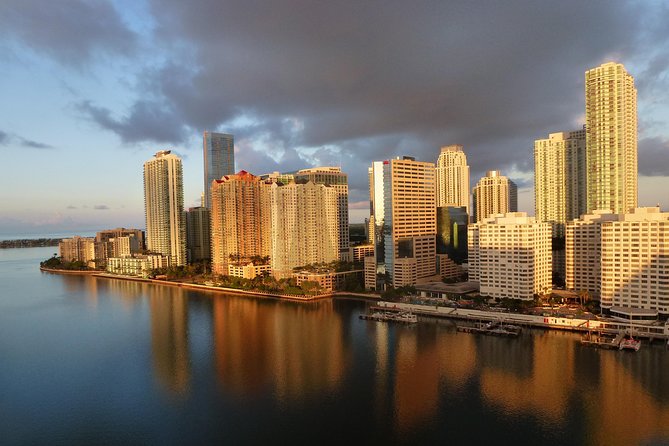
The tour calls out the six islands connected by the Venetian Causeway: Biscayne Island, San Marco Island, Di Lido Island, San Marino Island, Rivo Alto Island, and Belle Isle. This is a gift if you like structure and labels—because once you hear the names, you can try to match them to what you see below.
From the air, the Venetian Causeway looks like a tidy connection between separate worlds. It’s also a practical reminder that Miami isn’t one shoreline—it’s many. Each island feels like its own micro-neighborhood with its own waterfront identity.
If you’re the kind of traveler who likes to “learn while you look,” this section is where the live narration earns its keep. Even when the pilot’s words are brief, the naming helps you remember the route after the flight.
Coral Gables and Coconut Grove on the return: the neighborhoods behind the postcard
As you head back toward Miami Executive Airport, the flight includes passes over Coral Gables and Coconut Grove. These are different from the ultra-glossy beach-and-island zones, and that variety is a big value.
Coral Gables is the “city” vibe—more traditional neighborhood geometry, and a sense of development that doesn’t rely on islands to look impressive. Coconut Grove adds another layer: it feels more residential and textured, with the kind of shoreline blend that looks calmer from above.
You’ll also keep returning to the water view, especially as you approach the airport area. That repeated pattern—water, islands, skyline—helps you build a mental map fast.
Live narration through headsets: what you can expect and how to get the best version
The tour includes live narration and airplane headsets for everyone. That matters because you’ll hear what you’re passing over as the views roll by. Without audio guidance, you’d still see Miami. With audio, you start recognizing names and getting a sense of why each place is famous.
In some experiences, pilots have been described as friendly and interactive, with examples including Renata and Roberto. In other cases, commentary clarity can be a concern, like when the headset narration sounds too brief or hard to understand.
Here’s how you protect yourself from the bad version:
- Keep your headset fitted snug, and test volume right away.
- Ask the pilot to repeat a name if you missed it.
- Use your eyes first, then let the pilot’s context help you connect what you saw.
And don’t ignore the headset even when the views steal your attention. Miami from the air is stunning, but the narration is what turns it into a story you can talk about later.
Value check: $118.68 per person plus landing fees for 50 minutes in the air
At $118.68 per person for the core tour, plus $19.00 per person for landing and facility fees, you’re looking at a meaningful add-on. This is not a cheap way to see Miami.
So why do people still book it? Because you’re buying time and access. In about an hour, you cover multiple high-profile waterfront zones plus a skyline sweep, and you’re in a private setting with headsets and a professional commercial pilot.
Also, small details add real value. The plane is described as clean and safe in feedback, and the tour includes professional pilot time, photo/video permission, and free parking at the airport. If you’re coming from the hotel zone, that free parking can offset the hassle of getting to a less central airport.
Who gets the best deal
This tour tends to make the most sense for:
- Couples or two friends splitting the experience into a once-in-a-while splurge.
- People who already know Miami Beach well and want the parts that aren’t easy to see from streets.
- Photo-focused travelers who want an aerial angle that a drone trip can’t always match on schedule.
If you’re pinching pennies or you only have interest in one view, you might decide this is more than you need. But if you want many Miami “moments” in one flight, the math often feels fair.
What to bring, what not to bring, and how not to ruin the flight
You’ll want to keep it simple. You must bring a valid photo ID (driver’s license or passport). You can bring small handbags, but heavy or large bags can’t go into the airplane.
Don’t plan on snacks. Food and beverages aren’t allowed. The tour also bans smoking, drugs, and intoxication of vaping. It’s a short flight, but those rules make the cabin pleasant and calm.
Dress for windows and Florida weather. Lightweight clothes and flat, closed-toe shoes help for airport walks. If it’s cooler in the morning or evening, a light jacket can save you from the chill once you’re outside the plane.
And arrive early. You need to be at check-in 30 minutes before departure, or your tour duration can be reduced with no refund if you’re late.
Safety, comfort, and who should skip this flight
The tour is private and small-group, and many people highlight safety and professionalism. That said, the experience is still aviation, and the cabin is not built for everyone.
It’s not recommended for pregnant travelers more than 34 weeks. You should also think twice if you get motion sickness, have a fear of heights, or have limited mobility (and wheelchairs aren’t accommodated). If any of these apply, it’s worth choosing a different kind of sightseeing.
Weight limits also matter. The tour information lists a combined passenger limit of 490 pounds (220 kg) and a maximum per passenger of 250 pounds (113 kg). The FAQ also references an FAA guideline saying passengers over 280 lbs (127 kg) can’t be accommodated, with different totals mentioned for groups of three. Because those numbers conflict slightly, I’d treat this as a “confirm with the operator before booking” situation.
Finally, maximum group size is part of the plan. The tour is private, but your booking is for a small group (minimum 2, maximum 3). If you have more people, you’ll need separate bookings with back-to-back times.
Should you book this Miami airplane tour?
Book it if you want a high-impact Miami overview in under an hour, with a real pilot narrating the route and a small private setup that feels personal. It’s a strong choice for couples, for locals who want a “play tourist” day, and for anyone who wants aerial views of Fisher Island, Bal Harbour, Sunny Isles, and the Venetian Causeway islands without spending all day in transit.
Skip it (or ask hard questions first) if narration quality matters more than views, because live commentary can vary in clarity. Also skip it if you don’t fit the safety comfort profile—especially if you’re motion-sickness-prone, fear heights, have mobility constraints, or exceed the posted weight limits.
If you’re good with that, you’ll come away with a Miami map in your head and photos that look like you cheated.
FAQ
Where does the tour depart from?
It departs from Miami Executive Airport at 14359 SW 127th St, Miami, FL 33186. The activity ends back at the meeting point.
How long is the Miami airplane tour?
It’s listed as about 50 minutes to 1 hour (approx.).
What airplane is used for the tour?
The tour uses a Cessna 177 Cardinal for the sightseeing flight.
When should I arrive for check-in?
You should arrive 30 minutes before your scheduled departure time for check-in.
Is parking available at Miami Executive Airport?
Yes. Free parking is available.
What should I bring?
Bring a valid photo ID (driver’s license or passport). You can also bring small handbags. Heavy or large bags cannot be taken into the airplane.
Can I take photos or videos?
Yes. Photos and videos are allowed during the flight.
Is window seating guaranteed?
Yes. Every passenger gets a window seat and a headset connected to an intercom system.
Are there weight or capacity limits?
Yes. The tour lists a combined passenger weight limit of 490 pounds (220 kg) and a maximum per passenger of 250 pounds (113 kg). The FAQ also references an FAA guideline stating passengers over 280 lbs (127 kg) can’t be accommodated, with different totals mentioned for groups of three—so it’s important to confirm with the operator for your specific group.